Kathryn Burnham | February 13, 2017
Mouga Nfon Tut You Nyinyi has always been passionate about broadcasting, because he knows that radio is about more than sharing audio. He says, “We bring change, the adoption of new practices.”
He first got started in radio at university, and in 2001 was selected from among the youth in his community to participate in a broadcaster training before starting work at a community radio station.
He says: “I learned and retained as a broadcaster that radio is more than a mission to inform, to train, to amuse the public, [but that] it contributes to developing critical minds, citizenship values, democracy and good governance, in view of sustainable development of a community.”
Mr. Mouga Nfon is the station manager, as well as a producer and presenter, on Radio Ndah-Ngoh FM, which is based in Garoua-Boulaï in eastern Cameroon, near the border with the Central African Republic. The station broadcasts to both the Adamawa and East Regions, as well as parts of Central African Republic. In total, the station has about 30,000 listeners. The name of the station—Ndah-Ngoh—is derived from a nearby hill, “a symbol of the communication between the city’s founders and God,” says Mr. Mouga Nfon.
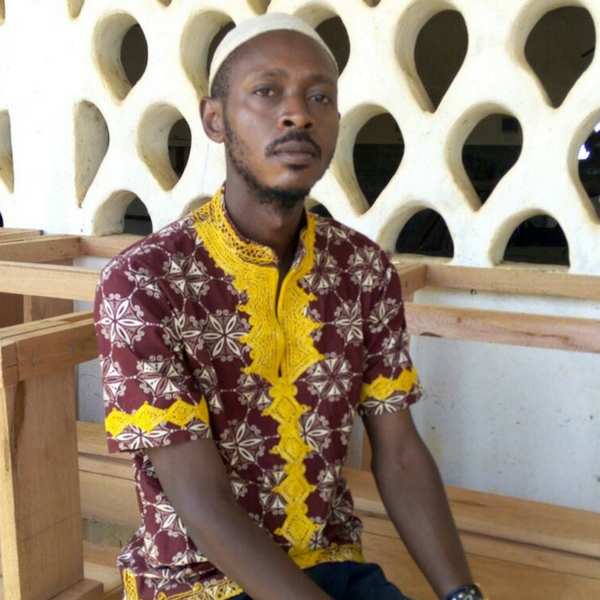
There are two agricultural programs on Ndah-Ngoh FM: Greniers et pâturages (Granaries and pastures) and Yéré Kpayono (Agriculture Moment in the Gbaya language). Mr. Mouga Nfon works on Greniers et pâturages, a program that discusses how to manage agropastoral challenges.
The two programs present information on new technologies, the use of pesticides, and climate change. They also discuss food security, storage, and marketing.
Mr. Mouga Nfon says, “We also respond to farmers’ problems with the help of agronomists and agricultural experts, who we invite [on the show].” He says the community radio station is so popular because they broadcast in five local languages: Gbaya, Fulani, Sango, Hausa, and Mboum.
But it’s more than language that connects the station to the community. Mr. Mouga Nfon says, “The second pillar of success lies in the fact that our community radio station provides local information produced by local people.”
He understands the impact of Ndah-Ngoh FM because the station has established a box to collect letters from the public. For example, one listener wrote: “I would like to start by thanking you for the latest episode of Greniers et pâturages. I was very pleased by the quality of the explanations of the agronomist on the program. He explained in simple terms the essentials on the use of fertilizers and herbicides. I appreciated the explanation on composting, and especially how to use fertilizers and herbicides for the production of five hectares of maize. I have already shared this experience with my listening club and we hope that this program will be rebroadcast. Thanks to your program, my production has doubled and I now manage to meet the needs of my daughter.”
The show Greniers et pâturages is one of the most popular on Radio Ndah-Ngoh FM. Mr. Mouga Nfon knows this because when he is absent, the phone lines are buzzing with listeners asking when the program will be back on air.